Is AI Recommending Your Business? How to Show Up When ChatGPT Answers
Nearly 800 million people use ChatGPT every week. When someone asks an AI assistant for the best contractor, restaurant, or service provider near them, that AI picks favorites. Here's how to make sure it picks you.
Something changed in how customers find local businesses — and most Eastern Shore business owners have no idea it happened.
Right now, nearly 800 million people use ChatGPT every week. Google's AI Overviews appear on a growing percentage of search results. Perplexity, Gemini, and Siri are all answering questions that used to send people to your website.
And here's the part that should get your attention: when someone asks an AI assistant "Who's the best HVAC contractor near Salisbury?" or "Where should I eat in Ocean City?" — that AI picks favorites. It recommends specific businesses by name. And if yours isn't one of them, you just lost a customer without ever knowing they were looking.
This isn't a prediction about the future. This is happening today.
The Shift from Search to AI Discovery
For the last 20 years, getting found online meant ranking on Google. You optimized your website, posted some content, maybe ran some ads, and waited for people to click through to your site.
That model is cracking.
Zero-click searches now account for roughly 60% of all Google queries. That means most people get their answer without ever visiting a website. Google's AI Overviews — those AI-generated summaries at the top of search results — reduce organic click-through rates by about 34.5% when they appear.
But it goes deeper than Google. Forty percent of Gen Z now uses AI chatbots to find restaurants, contractors, and service providers before they ever open Google. One in five US consumers has used ChatGPT specifically for local business discovery. And that number is growing every month.
The question isn't whether AI will change how customers find you. It already has. The question is whether the AI knows you exist.
What Determines Whether AI Recommends Your Business
AI assistants don't pull recommendations out of thin air. They synthesize information from multiple sources to decide who to suggest. Here's what matters most:
Your Google Business Profile. This is the single most important piece of your AI visibility right now. AI systems heavily weight Google's structured business data — your hours, services, photos, posts, and especially your reviews. A complete, active Google Business Profile with recent reviews is the foundation of getting recommended.
Review quality and recency. AI systems don't just count your stars. They read the actual text of reviews looking for specific service mentions, location references, and sentiment patterns. A business with 47 reviews averaging 4.7 stars that mention specific services ("great kitchen remodel," "fast AC repair") will get recommended over a business with 200 generic 5-star reviews.
Structured website content. When an AI crawls your site, it needs to understand exactly what you do, where you do it, and who you serve. That means clear service pages, location-specific content, proper schema markup, and FAQ sections that directly answer the questions people ask AI assistants.
Consistency across the internet. Your business name, address, phone number, and services need to match everywhere — your website, Google, Yelp, Facebook, industry directories, and Chamber of Commerce listings. Inconsistencies confuse AI systems and reduce your visibility.
Fresh content signals. AI systems favor businesses that demonstrate they're active and current. Blog posts, Google Business Profile updates, recent social media activity, and new reviews all signal that your business is operational and engaged.
The New Term You Need to Know: GEO
The marketing industry has a name for this: Generative Engine Optimization, or GEO. Think of it as SEO's successor. Where SEO optimized your visibility for Google's traditional search results, GEO optimizes your visibility for AI-generated answers.
LinkedIn's Big Ideas 2026 report predicts GEO will eclipse traditional SEO as the primary way businesses think about online visibility. That's a bold claim, but the data supports it. When an AI assistant gives a direct recommendation, there's no list of 10 blue links to compete for. There's one answer. Maybe two. You're either the recommendation, or you don't exist.
For local businesses, GEO isn't as complicated as it sounds. Most of the fundamentals overlap with good local SEO practices — the difference is in how you structure and present your information. AI systems reward clarity, specificity, and authority.
A Real Example: Restaurants and AI Discovery
Let's make this concrete. Say someone visiting the Eastern Shore opens ChatGPT and types: "What's the best seafood restaurant in Ocean City, Maryland for a family dinner?"
The AI is going to pull from Google Business Profile data, recent reviews, menu information, and any structured content it can find about local restaurants. It will look for mentions of "family-friendly," "seafood," and "Ocean City" in reviews and website content.
A restaurant with a complete Google profile, a menu on their website with schema markup, 50+ reviews mentioning "great for families" and "fresh seafood," and a blog post about their new spring menu — that restaurant gets recommended.
A restaurant with a basic website, no recent reviews, and a Google profile that hasn't been updated since 2023 — invisible. The AI doesn't know enough about them to recommend them confidently.
This same dynamic plays out for every industry. Contractors, property managers, real estate agents, hotels, salons — if an AI can't find structured, recent, specific information about your business, it will recommend someone else.
What You Can Do This Week
Here's a practical checklist you can work through right now to improve your AI visibility. None of this requires technical expertise or a big budget.
Step 1: Audit your Google Business Profile (30 minutes). Log into your Google Business Profile. Update your hours, add any missing services, upload 5+ recent photos, and write a post about something current — a seasonal offer, a completed project, a new menu item. Make sure your business description includes your specific services and the areas you serve.
Step 2: Ask for specific reviews (ongoing). Don't just ask happy customers for a review. Ask them to mention the specific service you provided and the location. "Would you mind mentioning the kitchen remodel in your review?" is far more valuable for AI visibility than a generic "Please leave us a review."
Step 3: Check your website's answer-ability (1 hour). Go through your website and ask yourself: if an AI read this page, would it know exactly what I do, where I do it, and why I'm good at it? Add FAQ sections to your main service pages. Create location-specific content if you serve multiple areas. Make sure every page has a clear, specific title and description.
Step 4: Test your AI visibility right now (10 minutes). Open ChatGPT, Gemini, or Perplexity and ask the question a potential customer would ask. "Who's the best [your service] in [your area]?" See if you show up. If you don't, you know exactly where you stand — and you know it's time to act.
Step 5: Ensure consistency across all listings (1 hour). Google your business name. Check every directory, social profile, and listing that appears. Make sure your name, address, phone number, website, and service descriptions match everywhere. Update anything that's outdated or inconsistent.
The Businesses That Move First Win
Here's what makes this moment different from any other marketing shift: AI recommendation is a winner-take-most dynamic. When a traditional Google search shows 10 results, all 10 businesses get some visibility. When an AI gives one recommendation, one business gets 100% of that opportunity.
On the Delmarva Peninsula, almost no local businesses are thinking about this yet. That's your advantage. The businesses that optimize for AI discovery now — while competitors are still debating whether AI matters — will own these recommendations for months or years before others catch up.
I'm watching this closely because it directly affects every marketing, development, and consulting engagement I take on. When I build websites, I'm now structuring them for AI readability from day one. When I manage marketing for clients, GEO is built into the strategy alongside traditional SEO. When I consult with businesses on their digital presence, AI visibility is part of the audit.
Want to Know Where You Stand?
I'm offering a free AI visibility check for Eastern Shore businesses. I'll search for your business across ChatGPT, Gemini, and Perplexity using the questions your customers would actually ask, audit your Google Business Profile, and give you a clear picture of where you stand — plus specific steps to improve.
Takes 30 minutes. No cost. No pitch.
Book a call, or try our AI chatbot at wolffcreative.com to see what 24/7 AI-powered lead capture looks like in action.
The way customers find businesses just changed. Make sure they can find yours.
Kevin Wolff is the founder of Wolff Creative, an AI-powered marketing and development company in Ocean City, MD. With 18+ years in enterprise technology and experience serving 5,400+ users, he helps Eastern Shore businesses navigate AI adoption and build digital presences that actually drive revenue. Visit wolffcreative.com for a free AI visibility audit.
Tags

About Kevin Wolff
Kevin is a web developer and digital strategist based in Ocean City, MD. He specializes in creating modern websites, SharePoint solutions, and digital marketing strategies that help businesses grow online.
Free: AI Readiness Checklist
Subscribe and instantly download our 15-question checklist to discover where AI automation can save you time and grow your business.
Related Articles
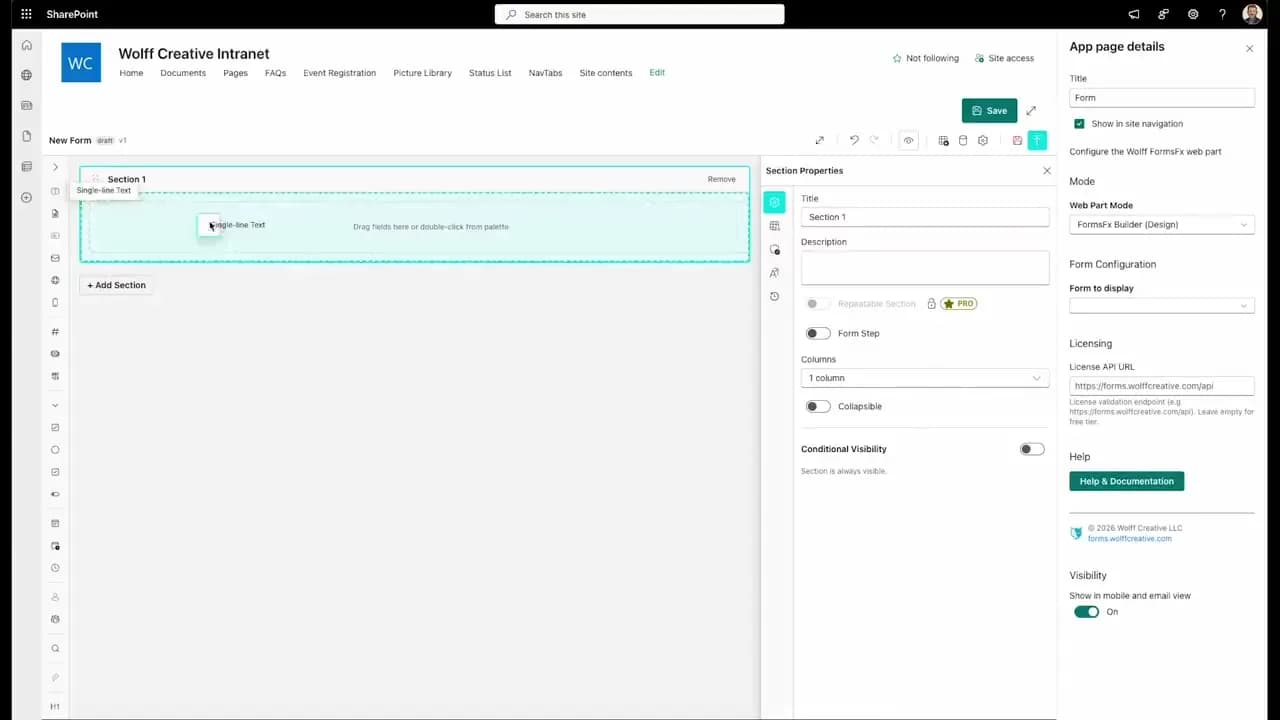
FormsFx: A Drag-and-Drop SharePoint Form Builder with Rules, Formulas, and Cascading Dropdowns
We built a SharePoint form builder that does what InfoPath did — conditional logic, calculated fields, cascading dropdowns — but runs natively as an SPFx web part. Here's how it works under the hood.
Read More →
FormsFx Has a Built-In Submissions Dashboard — Here's Why That Matters
Most SharePoint form builders stop at form submission. FormsFx includes a full dashboard for managing, searching, filtering, exporting, and approving submissions — no Power BI or custom views required.
Read More →
Offline Forms, Webhook Signatures, and Enterprise Connectors — FormsFx Beyond SharePoint Lists
FormsFx doesn't just write to SharePoint lists. It supports offline submission queuing, HMAC-signed webhooks for Power Automate, and enterprise connectors for SQL Server, Dataverse, REST APIs, and Azure Service Bus.
Read More →Need Help With This?
I help Eastern Shore businesses with web development, marketing, and AI automation. Let's talk about your project.
Need Help With Your Project?
Ready to take your business to the next level? Let's discuss how I can help.