The Anti-AI-Slop Guide: Creating Authentic Content That Stands Out in 2026
AI-generated content is everywhere—and audiences are tuning it out. Here's how to create authentic content that connects when everyone else sounds like a robot.
You've seen it everywhere. Blog posts that say nothing in 2,000 words. Social media captions that feel like they were written by a committee of robots. Email subject lines so generic they blur together in your inbox.
Welcome to the age of AI slop.
Gartner has officially placed generative AI in the "Trough of Disillusionment"—that phase where the initial hype crashes into reality. And the reality is this: AI-generated content is flooding the internet, and audiences are tuning it out faster than you can say "leverage synergies."
But here's the opportunity: while your competitors pump out forgettable AI-generated noise, you can create content that actually connects. Here's how.
What Is "AI Slop" and Why Should You Care?
AI slop is content that's technically correct but emotionally empty. It hits all the SEO checkboxes while missing the only box that matters: making a human being care.
You've seen it:
- Blog posts that define obvious terms for 300 words before getting to the point
- Social captions that start with "In today's fast-paced digital landscape..."
- Emails that could have been written for literally any business
- Website copy stuffed with buzzwords but empty of personality
The problem isn't AI itself. The problem is lazy AI usage—treating it as the author instead of an assistant.
Why AI Slop Is Failing
Here's what the data is showing in early 2026:
-
Engagement is dropping: Generic content gets scrolled past. Social media algorithms are rewarding meaningful engagement over volume.
-
Trust is eroding: Readers can sense when content is hollow. Once they feel deceived, they don't come back.
-
Everyone sounds the same: When every competitor uses the same AI prompts, differentiation disappears.
-
Google is catching on: Search algorithms increasingly reward expertise, experience, and authenticity—things AI struggles to fake.
The 7 Warning Signs Your Content Might Be AI Slop
Be honest. Does your content have any of these symptoms?
1. It Could Be About Anyone
Read your homepage. Now imagine your competitor's logo on it. Does it still work? If yes, you have a differentiation problem.
AI slop version:
"We're passionate about delivering innovative solutions that help businesses achieve their goals."
Authentic version:
"We build websites for Ocean City businesses that actually bring in customers—not just compliments from your cousin."
2. It States the Obvious
AI loves to pad content with definitions and context nobody asked for.
AI slop version:
"In the modern business environment, having a strong online presence is essential. A website serves as the digital storefront for your company, allowing potential customers to learn about your products and services."
Authentic version:
"Your website is losing you customers. Let's fix that."
3. It Uses "Leverage," "Utilize," or "Synergy" Unironically
These words are content crimes. They make everything sound like a corporate press release from 2003.
4. Every Sentence Could End with "...and that's why it matters"
AI loves false profundity. Real insights don't need to announce themselves.
5. There Are No Specific Details
AI can't tell you about the restaurant owner who doubled online orders after finally fixing her mobile menu. It can only speak in generalities.
6. The Voice Changes Paragraph to Paragraph
Authentic content has a consistent personality. AI slop often shifts tone because there's no real voice driving it.
7. You Can't Remember It Five Minutes Later
The ultimate test. If your content doesn't stick, it doesn't work.
How to Create Content That Actually Connects
Now for the practical part. Here's how to create authentic content in an AI-saturated world.
Start With a Real Point of View
Before writing anything, answer: "What do I believe that my competitors don't?"
Every piece of content should have a perspective. Not controversial for controversy's sake, but a genuine stance based on your experience.
Examples:
- "Most small business websites fail because they're built for the owner's ego, not the customer's needs."
- "SEO isn't dead—but the way most agencies do it should be."
- "Your logo matters less than you think. Your messaging matters more."
If you don't have a point of view, you don't have content worth creating.
Tell Specific Stories
Specificity is the antidote to AI slop. AI can generate "a restaurant saw increased revenue." Only you can tell the story of how Sal's Seafood Shack went from a 2-star Google rating to fully booked weekends after implementing a review response strategy.
Use:
- Real numbers (even if anonymized)
- Actual client scenarios
- Your own experiences and mistakes
- Local references your audience recognizes
Write Like You Talk
Read your content out loud. If you wouldn't say it in a conversation, don't write it.
AI slop:
"Implementing a comprehensive content strategy enables businesses to effectively communicate their value proposition to target audiences."
How a human talks:
"Good content helps people understand why they should choose you. Here's how to create it."
Have Opinions (and Back Them Up)
AI hedges. It gives you "it depends" and "there are many factors to consider." Sometimes that's appropriate. Often, it's cowardice.
If you've been in business for years, you know things. Share them directly:
- "WordPress is overkill for most small business websites."
- "Posting every day on social media is a waste of time for most local businesses."
- "That logo you're obsessing over? Your customers barely notice it."
Then explain why. That's content worth reading.
Include What AI Can't Know
AI doesn't know:
- What happened in your client meeting last Tuesday
- How your town has changed over the past decade
- The specific mistake you made on your first big project
- Why the standard advice doesn't work for your particular industry
This is your unfair advantage. Use it.
Edit Ruthlessly
AI generates bloat. Authentic content is lean.
For every sentence, ask:
- Does this add information or just words?
- Would the piece be worse without it?
- Am I saying this because it needs to be said or because I'm filling space?
Cut anything that doesn't earn its place.
Using AI as an Assistant, Not an Author
Here's the thing: I'm not anti-AI. I use AI tools regularly. The difference is how.
Good Uses of AI in Content Creation
Research acceleration:
- Summarizing long documents
- Finding statistics and data points
- Identifying questions your audience might have
First draft generation:
- Getting past the blank page
- Creating outlines to react to
- Generating options to choose from
Editing support:
- Checking grammar and clarity
- Suggesting simpler alternatives
- Identifying inconsistencies
Repurposing:
- Turning blog posts into social snippets
- Creating email subject line variations
- Adapting content for different platforms
Bad Uses of AI in Content Creation
Publishing AI output directly:
- No human review or personalization
- No addition of specific examples or expertise
- No voice consistency check
Replacing thinking with generating:
- Using AI to decide what to say instead of how to say it
- Letting AI determine your content strategy
- Outsourcing your point of view
Volume over value:
- Publishing more content because AI makes it easy
- Prioritizing SEO keywords over reader value
- Treating content as a checkbox instead of a connection
The 80/20 Rule for AI Content
Here's my approach: AI can contribute to about 20% of the content creation process—research, outlines, editing assistance. The other 80%—the thinking, the expertise, the voice, the specific examples—has to come from you.
If you flip that ratio, you get slop.
What Authentic Content Looks Like in Practice
Let me show you the difference with a real example.
AI Slop Version (Local SEO Blog Post)
"Local SEO is an essential component of digital marketing for small businesses. In today's competitive landscape, having a strong local search presence can help businesses attract customers in their geographic area. There are several key factors that influence local search rankings, including Google Business Profile optimization, local citations, and customer reviews. By implementing a comprehensive local SEO strategy, businesses can improve their visibility and drive more foot traffic to their locations."
Authentic Version
"Last month, a plumber in Salisbury asked me why his competitor—a guy with worse reviews and a uglier website—kept showing up above him in Google Maps. The answer took five minutes to find: his competitor had 47 Google reviews with responses. He had 12 reviews and hadn't responded to any of them.
Local SEO isn't magic. It's not even that complicated. But it does require doing the boring stuff consistently. Here's what actually moves the needle for service businesses on the Eastern Shore..."
Same topic. Completely different impact.
The Content Authenticity Checklist
Before publishing anything, run it through these questions:
Specificity Test:
- Does it include at least one specific example, number, or story?
- Could this only have been written by someone with my experience?
- Are there local or industry-specific details?
Voice Test:
- Does it sound like me when read aloud?
- Is the tone consistent throughout?
- Would my existing customers recognize this as my writing?
Value Test:
- Does this say something my competitors aren't saying?
- Will readers learn something or feel something?
- Would I share this if someone else wrote it?
Slop Test:
- Have I cut every unnecessary sentence?
- Are there any buzzwords I'm using without thinking?
- Does it get to the point quickly?
If you can't check most of these boxes, revise before publishing.
The Business Case for Authentic Content
This isn't just about craft—it's about results.
Authentic content converts better because it builds trust. When readers feel like they're hearing from a real person with real expertise, they're more likely to take action.
Authentic content ranks better because Google's algorithms increasingly reward E-E-A-T (Experience, Expertise, Authoritativeness, Trust). AI-generated content struggles to demonstrate genuine experience.
Authentic content compounds because people remember it, share it, and come back for more. Slop gets consumed and forgotten.
Authentic content differentiates in a market where everyone else is publishing the same AI-generated noise.
Getting Started: Your First Week
Here's a practical starting point:
Day 1-2: Audit your existing content
- Read your website copy, recent blog posts, and social media
- Identify what sounds generic vs. what sounds like you
- Note specific examples and stories you could add
Day 3-4: Define your voice
- Write down 3-5 opinions you hold about your industry
- Identify phrases you use naturally when talking to clients
- List topics where you have genuine expertise
Day 5-7: Create one piece of authentic content
- Pick a topic you care about
- Write from your experience, not from research alone
- Include at least one specific story or example
- Edit ruthlessly for clarity and voice
One piece of authentic content is worth more than ten pieces of slop.
The Bottom Line
AI isn't going away. The flood of AI-generated content will only increase. But that's actually good news for businesses willing to do the work of being authentic.
When everyone else sounds like a robot, being human is a competitive advantage.
Your customers aren't looking for more content. They're looking for content that helps them, content they can trust, content from someone who actually knows what they're talking about.
Give them that, and you'll stand out in 2026 and beyond.
Need help developing content that sounds like you and converts like crazy? Let's talk about your content strategy.
Tags

About Kevin Wolff
Kevin is a web developer and digital strategist based in Ocean City, MD. He specializes in creating modern websites, SharePoint solutions, and digital marketing strategies that help businesses grow online.
Free: AI Readiness Checklist
Subscribe and instantly download our 15-question checklist to discover where AI automation can save you time and grow your business.
Related Articles
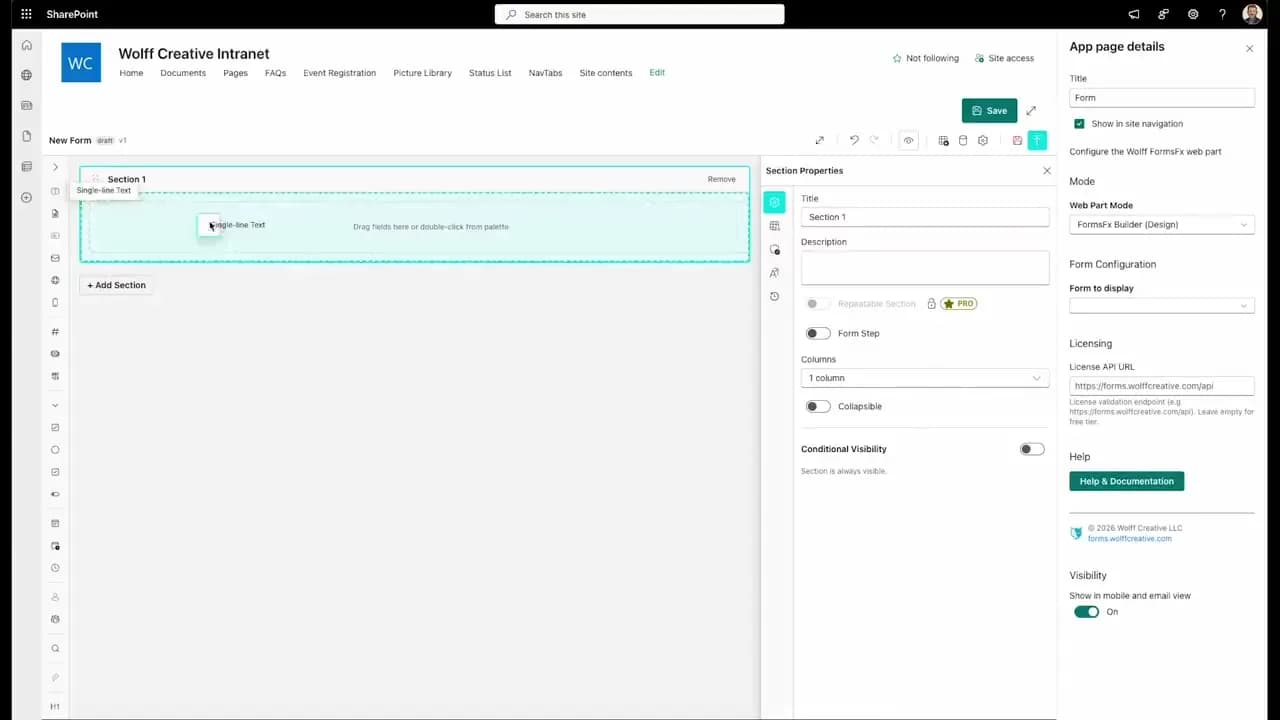
FormsFx: A Drag-and-Drop SharePoint Form Builder with Rules, Formulas, and Cascading Dropdowns
We built a SharePoint form builder that does what InfoPath did — conditional logic, calculated fields, cascading dropdowns — but runs natively as an SPFx web part. Here's how it works under the hood.
Read More →
FormsFx Has a Built-In Submissions Dashboard — Here's Why That Matters
Most SharePoint form builders stop at form submission. FormsFx includes a full dashboard for managing, searching, filtering, exporting, and approving submissions — no Power BI or custom views required.
Read More →
Offline Forms, Webhook Signatures, and Enterprise Connectors — FormsFx Beyond SharePoint Lists
FormsFx doesn't just write to SharePoint lists. It supports offline submission queuing, HMAC-signed webhooks for Power Automate, and enterprise connectors for SQL Server, Dataverse, REST APIs, and Azure Service Bus.
Read More →Need Help With This?
I help Eastern Shore businesses with web development, marketing, and AI automation. Let's talk about your project.
Need Help With Your Project?
Ready to take your business to the next level? Let's discuss how I can help.