How Many Leads Is Your Website Losing After 5pm?
Someone visits your website at 8pm, has a question, sees no way to get an answer, and leaves. Gone forever. Here's the math on what that's actually costing you.
It's 8:14 PM on a Tuesday. A homeowner three miles from your shop is sitting on their couch, phone in hand, searching for someone to fix their leaking roof. They find your website. It looks professional. Your reviews are solid. They have a question about whether you handle flat roofs.
There's no one to ask. Your phone goes to voicemail. Your contact form feels like dropping a message into a void. So they hit the back button and click the next result on Google.
You'll never know they existed.
This is happening on your website right now. Not occasionally — regularly. And the math behind it should make you uncomfortable.
Let's Do the Math
Say your website gets 500 visitors a month. That's modest for most small businesses running any kind of online presence — Google Business Profile, a few social posts, maybe some ads.
Industry data consistently shows that 3-5% of website visitors will convert when they're engaged at the right moment. Let's use the conservative end: 3%. That's 15 potential leads per month.
Now here's the part nobody thinks about. According to Google Analytics benchmarks, roughly half of all website traffic arrives outside of traditional business hours — evenings, weekends, holidays. For service businesses, it's often higher. People research contractors, restaurants, and local services when they're home from work.
So 7-8 of those 15 potential leads are visiting when nobody's there to answer.
If your average customer is worth $500, that's $3,500 to $4,000 per month walking out the door. If your average job is $2,000 or more — and for contractors, it often is — you're looking at $14,000 to $16,000 in potential revenue, gone. Every month.
Not because your marketing isn't working. Your marketing did its job — it got them to your website. The breakdown happens at the front door.
The Three Ways Businesses Try to Fix This
Option 1: The Contact Form
This is the default for 90% of small business websites. A name field, an email field, a message box, and a "Submit" button.
Here's the problem: people hate contact forms. They feel like shouting into a mailbox. There's no confirmation anyone will actually read it, let alone respond. Response rates on contact forms are notoriously low — most businesses take 24-48 hours to follow up, and many never do at all.
For after-hours visitors, the experience is even worse. They fill out a form at 9 PM. Maybe you see it the next morning. Maybe you call back at lunch. By then, they've moved on. Or worse, they filled out five other contact forms that night and went with whoever responded first.
Option 2: Extended Staffing
Some businesses try to solve this by staffing phones during extended hours. It works, but the economics rarely make sense for small businesses. Paying someone to sit by the phone from 5 PM to 10 PM costs $15-25 per hour. That's $375 to $625 per week, or $1,500 to $2,500 per month — for coverage that still doesn't handle weekends, holidays, or the 2 AM browsing session.
And most of those hours, the phone doesn't ring. You're paying for availability, not productivity.
Option 3: "We'll Call You Back"
The voicemail approach. "Leave a message and we'll get back to you within 24 hours."
This doesn't work anymore. Amazon, DoorDash, and every other instant-response service has rewired customer expectations. Research from Lead Response Management shows that 78% of buyers go with the first business that responds to their inquiry. Not the cheapest. Not the most qualified. The first.
When someone calls three businesses and yours is the one that calls back tomorrow morning, you're already the third choice.
The Fourth Option: An AI Chatbot That Knows Your Business
There's a reason this category has exploded over the past two years. An AI chatbot trained on your business solves the after-hours problem completely — without adding staff, without asking visitors to fill out a form they'll never trust, and without losing a single lead to slow response times.
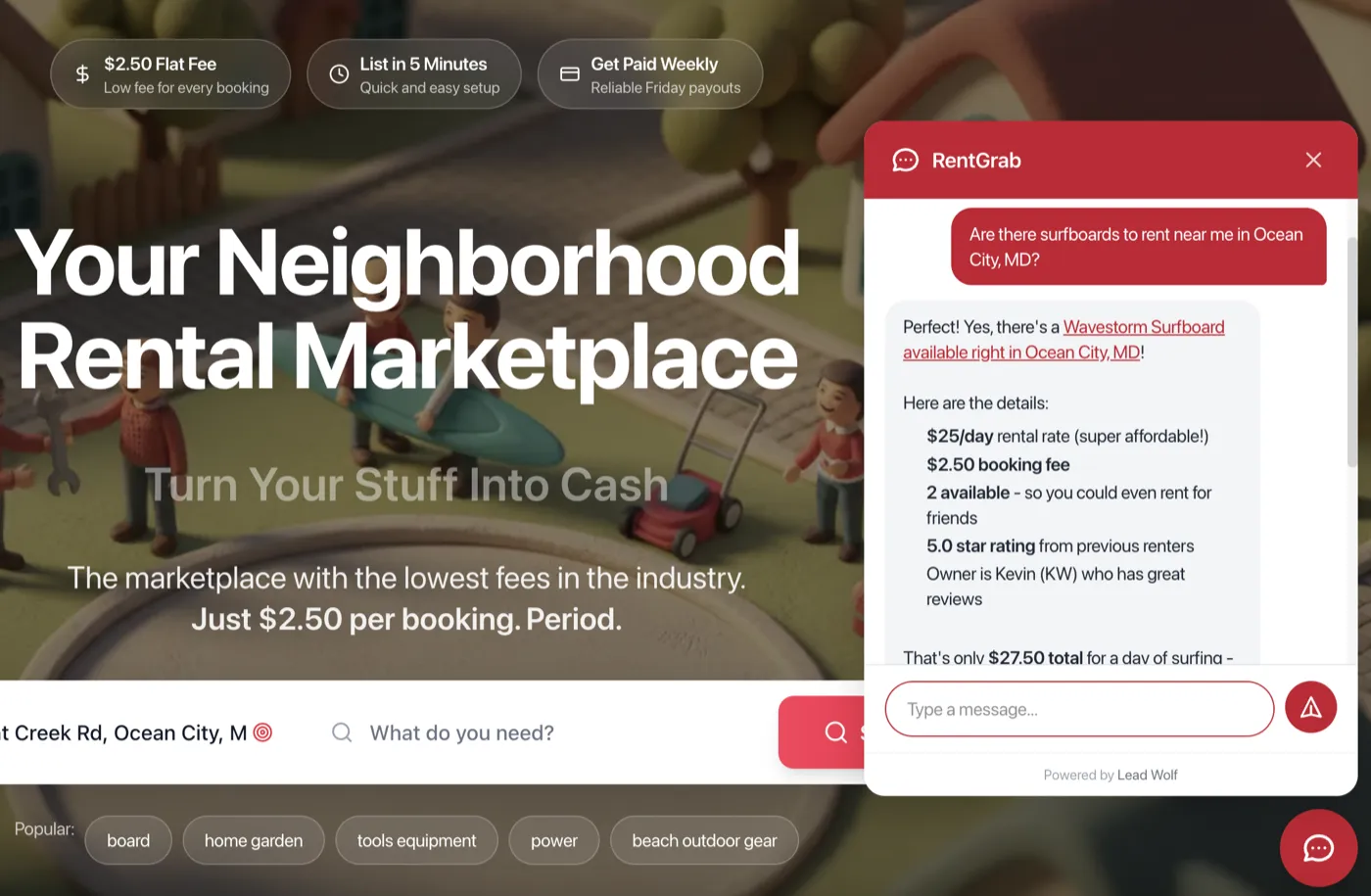
Here's what the experience looks like from the visitor's side.
A homeowner lands on a deck contractor's website at 9 PM on a Thursday. They're comparing three companies. Instead of a static page with a phone number, a chat window appears: "Hi! I can help answer questions about our decking services. What are you looking for?"
They type: "Do you guys do composite decking? We have a 400 square foot space."
The chatbot — trained on the contractor's actual services, materials, and service area — responds with real information. Yes, they offer composite decking. Here are the brands they work with. The typical range for a project that size. And would the visitor like to share their contact info so the contractor can follow up with a detailed estimate?
The visitor gives their name, phone number, and project details. The contractor wakes up the next morning to a qualified lead sitting in their inbox — complete with the full conversation. They know exactly what the customer wants, what they asked about, and how to open the call.
No missed opportunity. No cold form. No "we'll get back to you eventually."
This is exactly what LeadWolf does. Your AI chatbot scans your website, learns your business, and starts capturing leads immediately. Set it up in 5 minutes — no developers, no complicated integrations. Just paste one line of code. Start your free 14-day trial →
Why This Works Better Than You'd Expect
I hear the same objection from every business owner the first time: "My customers won't talk to a bot."
Here's what I've learned: they already are. Your customers use AI every day — Siri, Alexa, ChatGPT, Google's AI summaries. The technology isn't unfamiliar anymore. What matters is whether the chatbot is helpful or annoying.
A well-built chatbot doesn't feel like those terrible automated phone trees from 2010. It feels like texting with a knowledgeable assistant. It's conversational, it answers real questions with real information, and it gets the visitor what they need fast.
And here's the key comparison: the alternative isn't talking to you. The alternative at 9 PM is a voicemail nobody wants to leave, a contact form nobody trusts, or a bounce to your competitor's site. A chatbot that responds in three seconds beats all of those options.
The Real-World Scenario
Let me paint the full picture of how this changes a business.
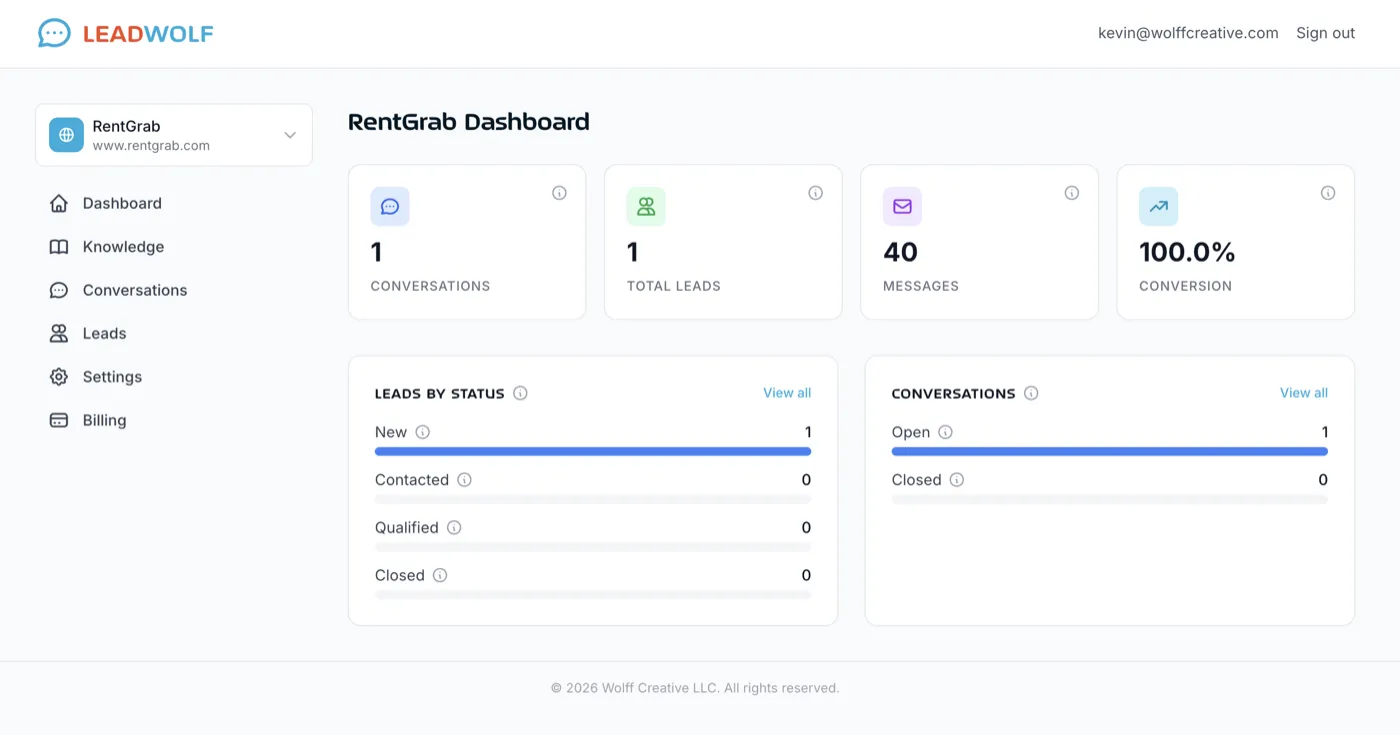
Before: A property management company in Ocean City gets steady website traffic — about 800 visitors a month. They have a contact form that generates maybe 5-6 leads per month. Most inquiries come through phone calls during business hours. They know they're missing evening and weekend traffic but don't have a solution.
After: They add an AI chatbot trained on their property management services, rental inventory, and service area. Within the first month, the chatbot handles 120 conversations. Of those, 22 visitors share contact information. That's nearly four times the leads they were getting from the contact form alone.
The chatbot captured inquiries about:
- A property owner looking for management services for a new vacation rental
- A tenant with a maintenance question who got an immediate answer
- A real estate investor asking about management fees and occupancy rates
- Three separate rental inquiries for the upcoming summer season
Every one of those conversations happened outside business hours. Every one of them would have been a bounce without the chatbot.
What About Contact Forms?
I'm not saying contact forms are useless. They still have a place — some people prefer forms, and they work well for specific requests (quote forms, appointment bookings, event inquiries).
The best approach is actually both. An AI chatbot for conversational engagement and immediate answers, plus a well-designed contact form for structured requests. They complement each other.
A chatbot handles the "I have a quick question" visitors who would never fill out a form. The form handles the "I know exactly what I need and want to submit details" visitors. Together, they capture leads that either channel alone would miss.
The ROI Math
Let's be conservative.
An AI chatbot like LeadWolf costs $99 per month. If it captures just two additional leads per month that you would have otherwise lost — two visitors who would have bounced at 8 PM — what's that worth?
If your average customer value is $500, that's $1,000 per month in potential revenue from two leads. At a 30% close rate, that's $300 per month in actual revenue. The chatbot pays for itself three times over.
But most businesses see more than two extra leads. The property management company I mentioned saw 22 in the first month. A contractor typically sees 8-12 new conversations per month. Even if only a quarter convert to actual customers, the ROI is dramatic.
Compare that to what you spend on Google Ads. You're paying $5-15 per click to drive traffic to your website. If half those clicks happen after hours and bounce because there's nobody to engage them, you're literally paying to lose leads.
The chatbot turns your website from a brochure into a 24/7 sales team.
Stop losing leads after 5 PM. LeadWolf is an AI chatbot and contact form platform built for small businesses. It scans your website, learns your business, and starts capturing leads tonight.
14-day free trial. No credit card required. 5-minute setup.
Getting Started Tonight
You don't need a developer. You don't need to overhaul your website. You need five minutes.
- Sign up and enter your website URL
- LeadWolf scans your site and learns your business automatically
- Copy one embed code and paste it on your website
- Start capturing leads — tonight
The visitors are already coming to your website. The question is whether you're there to meet them or whether you're letting them walk away to your competitor.
Every evening without a chatbot is another night of missed opportunities. And unlike most business investments, this one starts working the same day you set it up.
Kevin Wolff is the founder of Wolff Creative, an AI-powered marketing and technology company in Ocean City, MD. He built LeadWolf specifically for small businesses that need lead capture without enterprise complexity. Start your free trial or book a free consultation to see what AI automation could do for your business.
Tags

About Kevin Wolff
Kevin is a web developer and digital strategist based in Ocean City, MD. He specializes in creating modern websites, SharePoint solutions, and digital marketing strategies that help businesses grow online.
Free: AI Readiness Checklist
Subscribe and instantly download our 15-question checklist to discover where AI automation can save you time and grow your business.
Related Articles
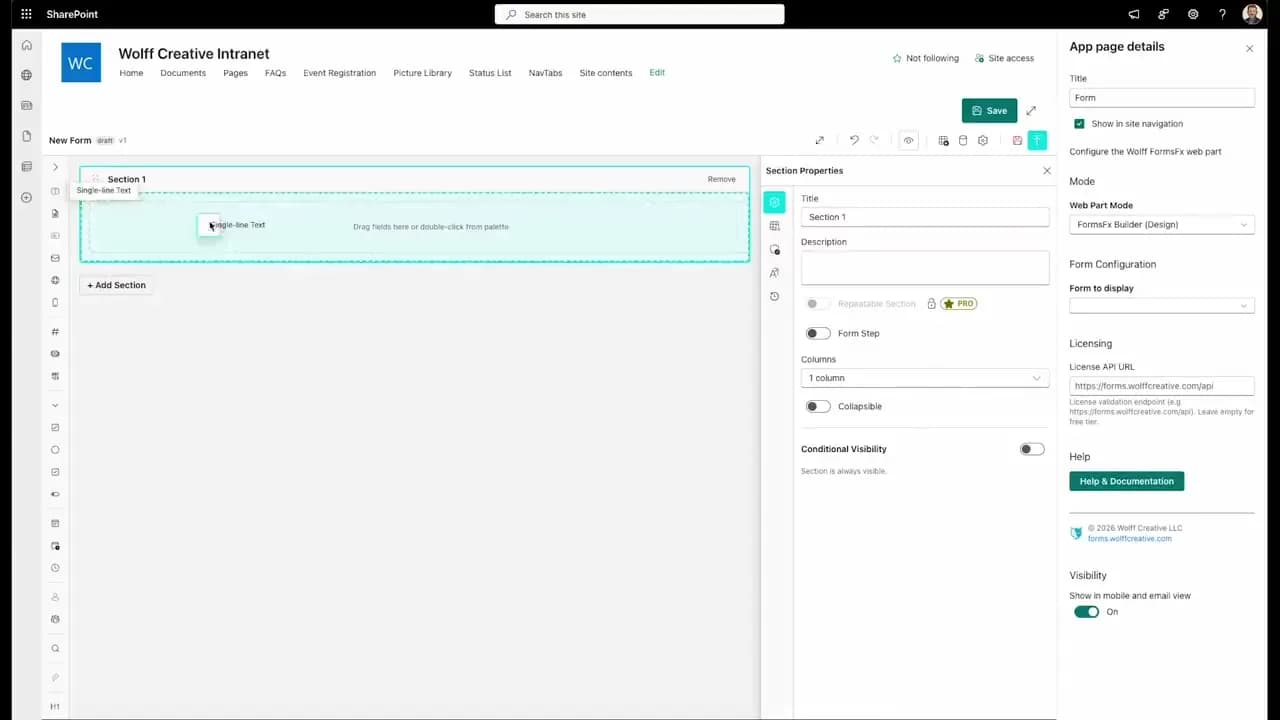
FormsFx: A Drag-and-Drop SharePoint Form Builder with Rules, Formulas, and Cascading Dropdowns
We built a SharePoint form builder that does what InfoPath did — conditional logic, calculated fields, cascading dropdowns — but runs natively as an SPFx web part. Here's how it works under the hood.
Read More →
FormsFx Has a Built-In Submissions Dashboard — Here's Why That Matters
Most SharePoint form builders stop at form submission. FormsFx includes a full dashboard for managing, searching, filtering, exporting, and approving submissions — no Power BI or custom views required.
Read More →
Offline Forms, Webhook Signatures, and Enterprise Connectors — FormsFx Beyond SharePoint Lists
FormsFx doesn't just write to SharePoint lists. It supports offline submission queuing, HMAC-signed webhooks for Power Automate, and enterprise connectors for SQL Server, Dataverse, REST APIs, and Azure Service Bus.
Read More →Need Help With This?
I help Eastern Shore businesses with web development, marketing, and AI automation. Let's talk about your project.
Need Help With Your Project?
Ready to take your business to the next level? Let's discuss how I can help.